Infant care · the smallest room

Babies keep
their own hours.
Infant care is its own craft — and its own set of questions.

Everything about a centre changes at the door of the infant room: the staffing rule tightens, the day stops having a schedule, and the questions a parent should ask get sharper. This page is those questions, answered where they can be and held where they can’t.

The infant group runs from six weeks to one year, and infant care is available through the night like every other group. How many infants one caregiver is responsible for is still held — see the infants section on Programs.

01What changes

The room where the rules are different.

A toddler room runs on routine. An infant room runs on each baby’s own clock — and everything else about it follows from that.

The clock

The schedule is the baby’s

Feeding on cue, sleeping on cue. A good infant room does not bend a four-month-old toward the building’s timetable — it keeps a record of each baby’s own day and follows it. Ask to see how that record is kept.

Nana’s Place Preschool Academy receives infants as early as 6 weeks old. We provide outstanding love and care for all our children, and use every opportunity for children to learn. Each infant’s individual feeding and napping schedule is well regarded, our infants are read to daily, and a daily record of mealtimes, diaper changes and naps is kept for each parent.

The staffing rule

The tightest ratio in the building

Every state writes its strictest staffing rule for infants, and Arizona is no exception: one caregiver to five infants. That is the tightest ratio the state sets, and it does not loosen at night.

The stakes

Sleep is supervised, by law

Arizona requires a caregiver to stay awake with sleeping children in any licensed centre. That is the state’s rule, not a courtesy — and it is the first thing to verify anywhere a baby will sleep.

Both buildings are Arizona Department of Health Services licensed child care centres — CDC-14018 and CDC-12417, checkable on AZ Care Check — run by the same family since 2005. You can look either one up before you call.

Infant care runs outside the standard daytime span — evenings and overnight included, and Northern on Sundays. Both licences carry the evening/nighttime and weekend classifications, and the infant group runs the building’s full hours. For how shift-working parents actually use that, see childcare for shift workers.

02Questions

What parents of babies ask first.

The same questions, in the same order, at every centre worth calling. And the answers, in plain terms.

The single most important number in infant care, and it belongs in writing, not in a reassurance. It comes from two places that must agree: the state rule and what the licence authorises. one caregiver to five infants — the tightest ratio Arizona sets, and it does not loosen at night Wherever you enrol, expect a straight number to this question — a centre that answers it with an adjective is answering a different question.

In any licensed Arizona centre, a caregiver who is awake — that is the rule, not a courtesy. Ask how sleep is checked and how often, and ask to see the sleep room. A written safe-sleep practice you can read beats any verbal assurance.

That is how an infant room should run: feeding on the baby’s schedule rather than the building’s. Tell whoever answers the phone how your baby actually eats and sleeps — the honest version — and listen for whether the answer is about your baby or about the room’s timetable.

The infant row of the rate table is published in full — no “call for pricing.” The calculator on the home page quotes the same weekly tuition charged at the front desk, by schedule, including the 10% sibling discount on each child after the first. Registration is $75, once, per family.

Yes. Evening and nighttime care is on both certificates, and the infant room runs the building’s full hours — babies are not the exception here.

03The bag

What to bring for a baby.

A baby travels with more equipment than a business trip. Packing it right the first week makes every handover shorter.

Every day

Bottles, labelled

Name and date on everything that gets swallowed, so nothing is ever offered to the wrong baby.

Every day

Diapers, wipes, cream — and spare clothes

More spare clothes than seems reasonable. Two full changes is the floor for an infant room day; label those too.

Once, at enrolment

Immunisation records

Arizona requires current records on file at a licensed centre. If anything is outstanding, say so on the phone — it is usually workable. The rest of the enrolment paperwork is one conversation: see what to have with you.

Comfort objects — a sleep sack, a particular blanket — are worth asking about rather than assuming: safe-sleep practice limits what can travel into a crib, and a good infant room will tell you exactly what is allowed and what waits in the cubby.

04Settling in

The first two weeks, honestly.

Babies settle; it just doesn’t look like settling at first. Knowing the shape of it beforehand is most of the comfort.
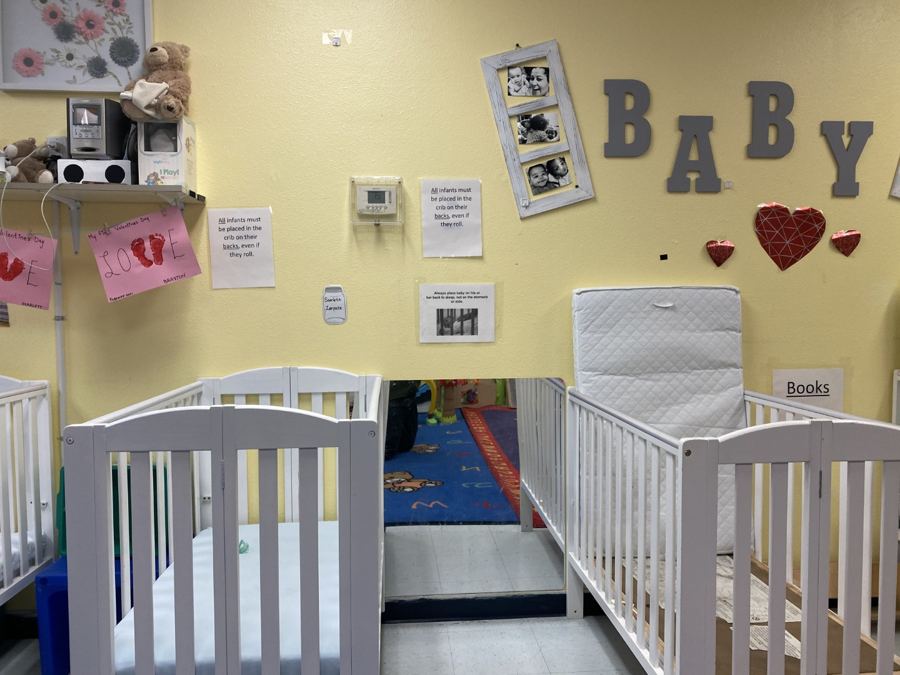
The infant room at Nana’s: white cribs along the wall, soft play mats on the floor.
Room 1 — the infant room. More photos →

Start shorter than you need

If your schedule allows it at all, a few short days before the first full one lets the room learn your baby while the stakes are low — and lets you see a handover happen before you have to trust one. Ask what a gradual start can look like against your actual start date; the answer will be about your dates, not a policy sheet.

Bring the baby’s day in writing: how they take a bottle, how they fall asleep, what the cry that means tired sounds like versus the one that means hungry. Nobody knows a baby like the person writing that page, and a good room reads it like an instruction manual because it is one.

Expect a wobble, then a rhythm

A regression in the first week or two — shorter naps, clingier evenings — is the normal cost of a new room, not a verdict on it. What to watch instead: whether the daily report matches the baby you pick up, and whether the same few faces are doing the handovers. Consistency of caregiver is the thing that settles a baby; everything else is furniture.

Drop-off and pick-up run around the clock, so a settling-in week can be built around your shift rather than around ours.

What the infant room costs

Published in full, like every rate on this site. The calculator quotes the infant weekly rate by schedule — the same table the front desk charges from — with the 10% sibling discount run out for you. Registration is $75, once, per family. DES child care assistance is accepted at both locations.

six weeks to one year

Ask about your baby, not babies.

Tell either building your baby’s age, how they eat and sleep, and when you need care. The useful answers — the ratio, the room, the week’s cost — come fastest on the phone. Then walk the building before you decide anything.

Peoria · (623) 931-5015 Northern · (623) 435-2211