Toddlers & preschool · the middle years

The loud,
busy years.
Between the infant room and a school desk, everything happens.

Walking becomes running, sounds become sentences, and playing next to other children becomes playing with them. Four of the six groups at Nana’s live in these years — and what they share is a day with a shape a child can lean on.

The four group names on this page — One year, Two years, Three years, Pre-Kinder — run from one year to five, feeding into school age at five. How many children one caregiver has in each is still held; see Programs.

01The day’s shape

Routine is what a toddler holds onto.

A two-year-old cannot read a clock, but reads the order of things perfectly: what comes after arriving, what comes after outside. A day with a dependable shape is the whole trick — especially for a family whose own week keeps changing.

The morning

Arrive, land, get busy

A drop-off that is short and the same every time, then the room’s big block: free play, a gathered circle, the messy table. Mornings are where the learning is, because mornings are where the energy is.

The middle

Then quiet

The middle of the day is the rest, and it anchors everything either side of it — the morning winds down into it and the afternoon starts from it.

The afternoon

Outside, and out the door

The afternoon runs at a lower boil — outside time, quieter tables, and a wind-down that hands each child back in one piece. The order holds even when the pick-up hour doesn’t.

Art, music, dance and theater run as part of the programme, alongside fitness — the family has described the approach that way for years: an academic programme children reach through exploring those things rather than sitting still for them.

02Early learning

What learning looks like before it looks like school.

Nobody teaches a two-year-old to talk. You surround them with talk and they take it. Early learning at this age is mostly building the room where that happens.
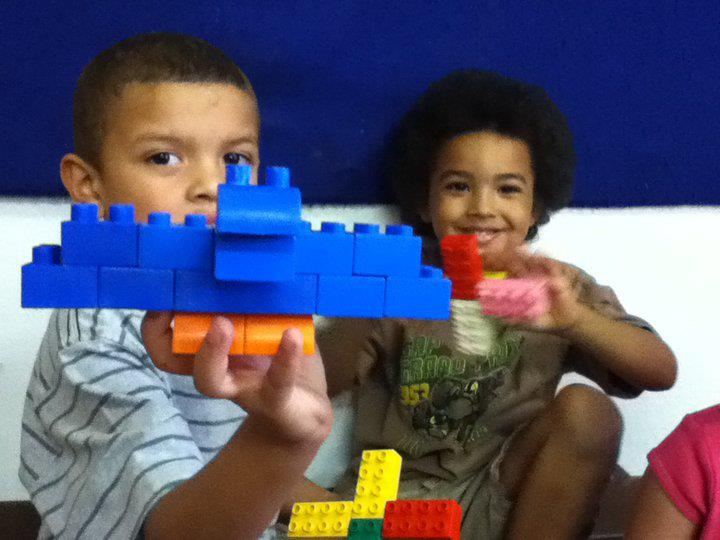
Two children at Nana’s building a tall tower out of blocks together.

One and two: sideways learning

Toddlers do most of their learning off other toddlers — watching, copying, negotiating over the same red crayon. The adult’s job is narration and safety: naming everything, reading the same book the fortieth time, catching the climber. A room that looks like chaos and sounds like a running commentary is a room doing it right.

The year between one and two is when consistency starts to outrank novelty — the same faces, the same order of things. That matters double for children whose home schedule rotates.

Three to Pre-K: a classroom emerges

From three, the day gets a curriculum in it rather than a rhythm alone — letters, numbers, songs with rules, projects that take more than one sitting. Pre-K is judged on one thing a year later: whether the child walked into kindergarten able to handle its shape. That means letters and numbers, but it mostly means attention, transitions and finishing what was started.

The centre’s director holds a master’s degree in special education — which matters most at exactly this age, when differences between children start to show up as something other than temperament.

Each group’s own section — with its held ratio ring and its rate — is on the Programs page: One year · Two years · Three years · Pre-Kinder.

03Transitions

Every hard moment is a transition.

Drop-off, nap, moving up a room, starting kindergarten — the crying almost never happens during anything. It happens at the seams.

Daily

Drop-off and pick-up

Short, warm, and identical every time is the whole recipe. A drawn-out goodbye reads to a toddler as doubt. Hand over, name what happens next — “outside, nap, then Mama” — and go; the tears usually outlive the doorway by about a minute.

Occasional

Moving up a room

The move from one group to the next is worth asking about anywhere you enrol: how it is decided, how long the visit-first period is, and how it is timed around the child rather than the calendar. Ask for the answer as a plan for your child, and expect one.

Once

Out the door to kindergarten

The last transition is the one Pre-K exists for. What a kindergarten teacher hopes arrives in August: a child who can sit in a circle, follow a two-step instruction, manage a coat, and lose a game without losing the morning.

The move between groups follows the age spans above — one to two, two to three, three to four, four to five — but readiness matters as much as a birthday. Ask on the phone and you will get the real answer for your child’s case.

04Cost

Four groups, every schedule, no asterisks.

The whole table, published — these are the rates charged at the front desk, the same numbers you would be quoted on the phone.

The calculator on the home page answers one family’s exact case in thirty seconds: pick the group, the schedule and the number of children, and it runs the 10% sibling discount for you. Registration is $75, once, per family. Drop-in days are available. DES child care assistance is accepted at both locations.

one to five years, in four groups every group runs the building’s full hours, including overnight

Ask about your child’s year.

One-year-olds and Pre-K children are different jobs. Tell either building your child’s age and your schedule — the honest version — and you’ll get the room, the routine and the weekly rate in one call. Then walk the building.

Peoria · (623) 931-5015 Northern · (623) 435-2211